










Posted: Jun 17, 2019
The "Non-Story" of Johnson College Prep Baseball Coach Laura McKelvey
By Emily Iannaconi
If there is anything coach Laura McKelvey knows on this first day of practice, it is to focus on mechanics. She had sized up the small turf soccer field prior to today - trying to determine which drills she could and couldn't do on the practice space at Johnson College Prep in Chicago's Englewood neighborhood. One by one, boys walk out onto the field, a hand-me-down glove from Play it Again sports dangling from each hand. This is her baseball team.
After the boys line up for drills, balls start flying. The throws are not crisp or clean. McKelvey is so busy chasing down thrown-away balls that she is hardly paying attention to anyone's mechanics. "I'm in evaluation mode," McKelvey says. "I'm trying to figure out if you know how to play or just want to play."
She decides to do a drill that she learned from her high school softball coach. It's about throwing accuracy and it's also supposed to build team camaraderie if it's done right. She lines the boys up and gives each a baseball. "This line is throwing at each other and this line is throwing at each other," McKelvey explains. "The goal is to make the balls hit in the middle. If you're having nice, straight-line throws at the same time with precision, they should hit. I used to do it at my practices every day in high school until the balls hit."
McKelvey remembers that her high school team would complete the drill in two-three minutes. Fifteen minutes later, the Johnson players still haven't gotten the baseballs to hit. McKelvey cuts the drill short. She understands in that moment what she's up against.
Laura McKelvey is from all over the country but has spent most of her time in the Midwest. Her family is from Ohio and McKelvey attended The Ohio State University for college. Originally, she thought she would be on the pre-medical track because of her love for science, but she eventually realized that she did not want to be a doctor. She came back to her original plan that she made at five years old, which was to teach. "My whole family is teachers. Mom, aunts, uncles, grandma, cousins," McKelvey says. "It was what I had always known I should do but people had kind of talked me out of it." She joined Teach for America right out of college and was placed at Johnson, and has been teaching chemistry there ever since.
McKelvey is the only female baseball head coach in the Noble League, which includes 17 college prep high schools primarily on the South and West Sides of Chicago. "People are usually surprised," McKelvey says. "They ask why I'm here [at games]." McKelvey does not see herself as particularly original or remarkable for coaching a boys team though. She simply sees herself as "coach."
Athletic director Jack Greenfield hired McKelvey and said that she is breaking down gender roles on a daily basis. "It goes to show that you can do anything," Greenfield said. "It doesn't matter who you are, you need knowledge and passion and that's all that matters." He knows that McKelvey is serving a role model to Johnson students.
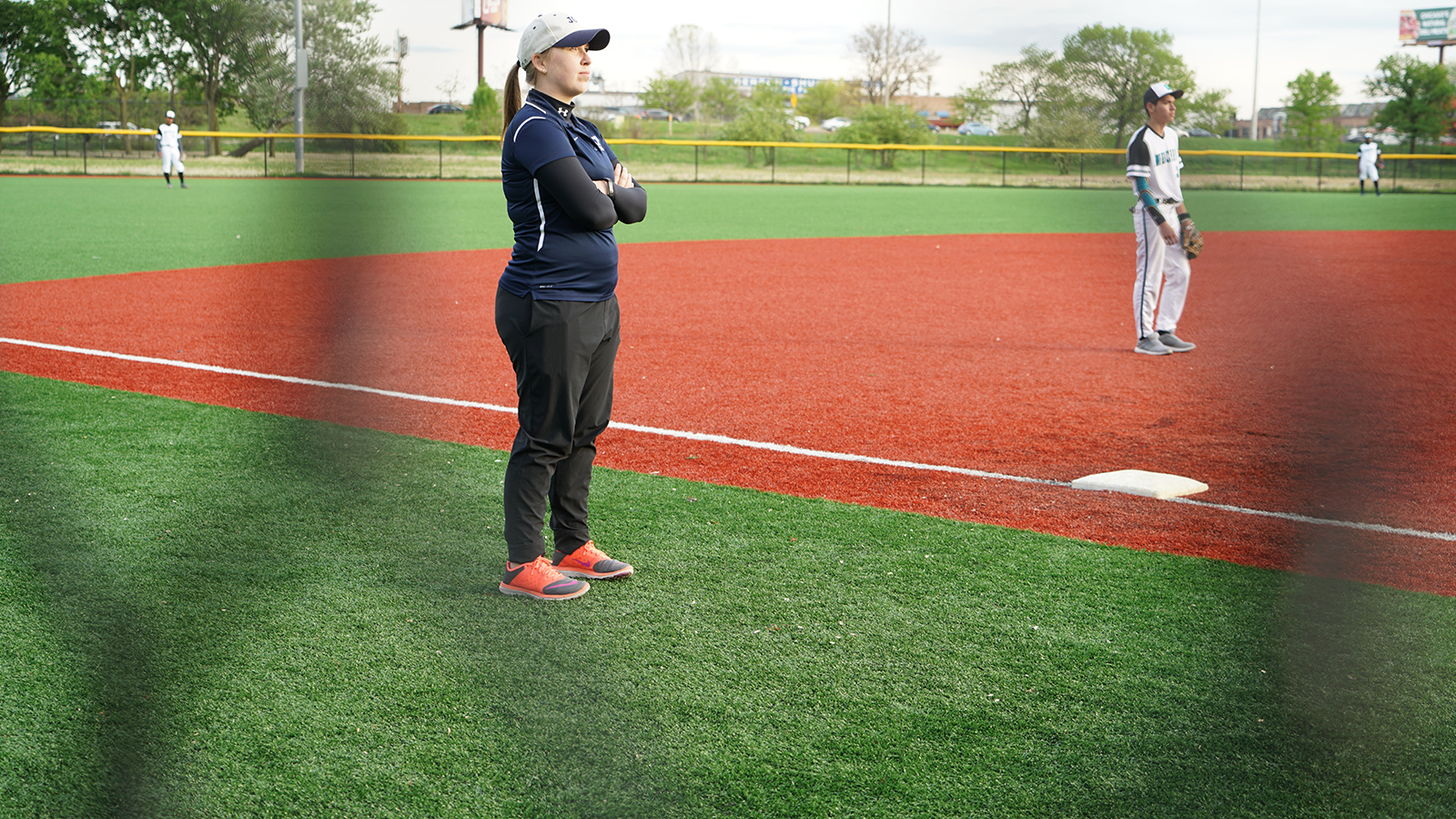
For McKelvey, coaching the Johnson baseball team feels like a "non-story." But to most people, seeing McKelvey serve as third base coach during games, a role reserved for the head coach of a team, feels both different and unusual. Whether she realizes it or not, McKelvey is challenging a gender norm on the baseball diamond as she continues to prove that a woman can coach a man's game.
McKelvey's love of sports started when she began playing t-ball at four years old. Her mom, Carol-Lyn, remembers Laura resting her little red glove on her knees in the outfield, just waiting for a ball to come her way.
McKelvey came from a family of athletes. Her grandfather was on track to play professional baseball before he got hurt. "He passed it down to all of us," McKelvey says. McKelvey also grew up with older cousins who are all boys. Along with her younger sister Kristen, McKelvey attended baseball camp at eight years old and played alongside the boys.
The McKelvey's moved to Kansas City when McKelvey was in middle school and it was then that she began playing softball. Carol-Lyn, Laura, Kristen and McKelvey's dad, Steve attended Kansas City Royals games together. Steve helped out as a coach on McKelvey's softball teams and was there when she started playing catcher at 10 years old. "I wanted to play in every game and they wouldn't let me pitch," McKelvey says. "The only thing that would guarantee me to play in every game was to play catcher. I didn't want to have to wait. And nobody notices you until you mess up. So I was like 'I can do that. Then I can play every game and no one will ever want to compete with me.'"

Steve noticed his daughter's leadership on the field when she was young. He says that she always knew the plays well and she was good at making sure everyone understood what they were doing and why they were doing it. "She ran the field as a catcher," McKelvey's father says. Carol-Lyn adds that McKelvey started calling pitches early in her career - the true sign that a catcher has earned both her pitcher's and coach's trust.
In addition to softball, McKelvey also played basketball in high school. Steve remembers McKelvey's first game as a freshman when she nailed a three-pointer on her first attempt. But in most of her games throughout high school, McKelvey rode the bench. The starting point guard went on to play at the college level and McKelvey knew that she would never be as good as her. "But I could guard her every day at practice and try to make her better so that the team was ready," McKelvey says. "I took that seriously."
Though McKelvey did not see a lot of playing time during her basketball career, her coach, Jeff Simpson, became a mentor and friend throughout McKelvey's four years. Simpson began by coaching boys basketball and then he transitioned to the girls' team. He approached both jobs the same way though. "We're coaching athletes," Simpson says. "We're not coaching boys or girls." Simpson says that there is a perception that boys have to be coached differently than girls. " 'We're not going to treat you like girls," Simpson told the team. "We're going to treat you like athletes." To Simpson, there is no difference. "Kids that put more time into it get more out of it," Simpson says. "There's no doubt about that regardless of gender."
McKelvey chose to continue playing softball at the college level when she joined the club team at Ohio State. She was the starting catcher all four years. Her desire to teach led her to Teach For America, which placed her at Johnson College Prep. The teacher who had coached the baseball team the year before had left. So when Johnson's athletic director, Jack Greenfield, asked his staff if anyone wanted to coach the baseball team, McKelvey raised her hand. "I would love to," she said.
McKelvey proved that she knew what she was doing as soon as she threw the ball on that first day of practice. From that point forward, she worked on growing her team. McKelvey says that consistency has been her biggest asset when it comes to attracting players. It helped when, three years ago, the team transitioned from a JV to a varsity program because there are more varsity teams in the Noble League for the Pumas to compete against.
She said that she saw a real shift take place this past season when the team received a grant from the Cubs Charities that allowed them to buy and replace old equipment. A high school baseball rule change made the previously donated bats illegal and so the team had to borrow bats from other teams during games. The grant gave McKelvey the money to replace the bats. "I purposely brought the bats in with the price tags on them, wrapped in plastic to show the kids," McKelvey says.
The money also allowed McKelvey to replace the uniforms. Letters were peeling off the old uniforms and McKelvey did not even have enough of them for more than nine players. The players are allowed to wear their new jerseys on game days. Now the younger students see upperclassmen walking around in real varsity uniforms and they want to be a part of the team. Students began approaching McKelvey mid-season asking to join the team and she had to tell them that tryouts were months before. McKelvey says that she is still working on teaching that accountability, but their are improvements every year. "We're starting to look like and feel more like a varsity program," McKelvey says.
In addition, the Pumas have never been able to have batting practice because their practice space is too close to nearby parking lots and buildings. For years, the players only took dry swings at practice, swinging at the air. The money from Cubs Charities allowed McKelvey to purchase a batting net that now allows the team to take real swings
Throughout this growth, McKelvey has faced very little pushback for being a woman. She had an umpire a couple of years ago who kept calling her "sweetheart" during a game, but she straightened that out in the early innings using the same confidence that has allowed her to talk to umpires since she was in middle school.

McKelvey practices alongside her players, doing wall-sits in the hallways and hitting ground balls across the field. At first, pitcher Jalen Griffin only knew McKelvey as his chemistry teacher. "So when it came to coaching, Jalen says, "It didn't feel any different. It was just a little bit different because this is the first time I had a woman coaching baseball. But it wasn't bad. I feel like she's done the same thing that a man coach would do and even more."
Jalen explained that McKelvey balances being serious and joking around, making practices both fun and helpful. He said that the intensity of the practices has increased but the expectations are still realistic. Jalen did not know a lot about pitching when he first started. Before McKelvey could teach him how to throw a baseball pitch, she had to teach herself. Softballs are more round but less dense than baseballs, so being a catcher all her life did not help her now. McKelvey remembers watching "How to Pitch" YouTube videos and buying books on pitching.
"I know she does so much for us that we don't even see," Jalen said. "The sacrifices she makes, first being a woman coaching an all-boys team. Then for her to run practice and make sure our schedule is right with buses all by herself. I'm appreciative that I'm able to be around her and able to take those things that she's instilled in us to the next level. I know she loves the game. She knows we love the game."
For Jalen and the boys on the Johnson Pumas baseball team, it's as simple as that.
Johnson is ready to play Muchin in the first round of the Noble League baseball championship on a Monday evening at the end of May. Church bells ring out nearby as the sun starts to set and the temperature drops. Someone turns on the field lights. The game has been delayed an hour because the umpires are late. McKelvey is killing time by juggling and doing drills with the players to keep them warmed up. I ask McKelvey about the drill she did with the team in practice five years ago when she first arrived at Johnson. I'm wondering if the players ever got the balls to hit.
Her eyes get big and a smile spreads across her face. She says that the players have gotten the balls to hit twice this past season. "That level of joy - they were giving a challenge that in previous years has not been met, and they got it," McKelvey says. "It's the most magical moment."
"The fact that they are kids who show up to work hard, that's more impressive to me than me doing my job," McKelvey said. "Because how many teachers coach? So many. All of the kids that leave here have seen that women can coach men's sports. They know it's a fact."
Moving forward, McKelvey wants Johnson College Prep baseball to become more competitive in the Noble League. She accepts the poor records of the past couple of years and hopes that the program can gain more relevance with time and resources. McKelvey believes that, as the players master mechanics, they will be better able to employ more sophisticated strategies for in-game situations like a true varsity program. "My vision is that when we have practice time together, we are working more on what will happen when we get on base, as opposed to building the skill-set so that getting on base can happen in the first place," McKelvey said. McKelvey also knows that it would help her team to be able to partner with local teams or colleges so that her student-athletes can see real facilities.
In the meantime, McKelvey said that she feels lucky to have the opportunity to coach at Johnson. "I am a teacher," McKelvey said. "My real passion is as an educator. And I love baseball. It is the most fun thing in the world."

If there is anything coach Laura McKelvey knows on this first day of practice, it is to focus on mechanics. She had sized up the small turf soccer field prior to today - trying to determine which drills she could and couldn't do on the practice space at Johnson College Prep in Chicago's Englewood neighborhood. One by one, boys walk out onto the field, a hand-me-down glove from Play it Again sports dangling from each hand. This is her baseball team.
After the boys line up for drills, balls start flying. The throws are not crisp or clean. McKelvey is so busy chasing down thrown-away balls that she is hardly paying attention to anyone's mechanics. "I'm in evaluation mode," McKelvey says. "I'm trying to figure out if you know how to play or just want to play."
She decides to do a drill that she learned from her high school softball coach. It's about throwing accuracy and it's also supposed to build team camaraderie if it's done right. She lines the boys up and gives each a baseball. "This line is throwing at each other and this line is throwing at each other," McKelvey explains. "The goal is to make the balls hit in the middle. If you're having nice, straight-line throws at the same time with precision, they should hit. I used to do it at my practices every day in high school until the balls hit."
McKelvey remembers that her high school team would complete the drill in two-three minutes. Fifteen minutes later, the Johnson players still haven't gotten the baseballs to hit. McKelvey cuts the drill short. She understands in that moment what she's up against.
Laura McKelvey is from all over the country but has spent most of her time in the Midwest. Her family is from Ohio and McKelvey attended The Ohio State University for college. Originally, she thought she would be on the pre-medical track because of her love for science, but she eventually realized that she did not want to be a doctor. She came back to her original plan that she made at five years old, which was to teach. "My whole family is teachers. Mom, aunts, uncles, grandma, cousins," McKelvey says. "It was what I had always known I should do but people had kind of talked me out of it." She joined Teach for America right out of college and was placed at Johnson, and has been teaching chemistry there ever since.
McKelvey is the only female baseball head coach in the Noble League, which includes 17 college prep high schools primarily on the South and West Sides of Chicago. "People are usually surprised," McKelvey says. "They ask why I'm here [at games]." McKelvey does not see herself as particularly original or remarkable for coaching a boys team though. She simply sees herself as "coach."
Athletic director Jack Greenfield hired McKelvey and said that she is breaking down gender roles on a daily basis. "It goes to show that you can do anything," Greenfield said. "It doesn't matter who you are, you need knowledge and passion and that's all that matters." He knows that McKelvey is serving a role model to Johnson students.
For McKelvey, coaching the Johnson baseball team feels like a "non-story." But to most people, seeing McKelvey serve as third base coach during games, a role reserved for the head coach of a team, feels both different and unusual. Whether she realizes it or not, McKelvey is challenging a gender norm on the baseball diamond as she continues to prove that a woman can coach a man's game.
McKelvey's love of sports started when she began playing t-ball at four years old. Her mom, Carol-Lyn, remembers Laura resting her little red glove on her knees in the outfield, just waiting for a ball to come her way.
McKelvey came from a family of athletes. Her grandfather was on track to play professional baseball before he got hurt. "He passed it down to all of us," McKelvey says. McKelvey also grew up with older cousins who are all boys. Along with her younger sister Kristen, McKelvey attended baseball camp at eight years old and played alongside the boys.
The McKelvey's moved to Kansas City when McKelvey was in middle school and it was then that she began playing softball. Carol-Lyn, Laura, Kristen and McKelvey's dad, Steve attended Kansas City Royals games together. Steve helped out as a coach on McKelvey's softball teams and was there when she started playing catcher at 10 years old. "I wanted to play in every game and they wouldn't let me pitch," McKelvey says. "The only thing that would guarantee me to play in every game was to play catcher. I didn't want to have to wait. And nobody notices you until you mess up. So I was like 'I can do that. Then I can play every game and no one will ever want to compete with me.'"
Steve noticed his daughter's leadership on the field when she was young. He says that she always knew the plays well and she was good at making sure everyone understood what they were doing and why they were doing it. "She ran the field as a catcher," McKelvey's father says. Carol-Lyn adds that McKelvey started calling pitches early in her career - the true sign that a catcher has earned both her pitcher's and coach's trust.
In addition to softball, McKelvey also played basketball in high school. Steve remembers McKelvey's first game as a freshman when she nailed a three-pointer on her first attempt. But in most of her games throughout high school, McKelvey rode the bench. The starting point guard went on to play at the college level and McKelvey knew that she would never be as good as her. "But I could guard her every day at practice and try to make her better so that the team was ready," McKelvey says. "I took that seriously."
Though McKelvey did not see a lot of playing time during her basketball career, her coach, Jeff Simpson, became a mentor and friend throughout McKelvey's four years. Simpson began by coaching boys basketball and then he transitioned to the girls' team. He approached both jobs the same way though. "We're coaching athletes," Simpson says. "We're not coaching boys or girls." Simpson says that there is a perception that boys have to be coached differently than girls. " 'We're not going to treat you like girls," Simpson told the team. "We're going to treat you like athletes." To Simpson, there is no difference. "Kids that put more time into it get more out of it," Simpson says. "There's no doubt about that regardless of gender."
McKelvey chose to continue playing softball at the college level when she joined the club team at Ohio State. She was the starting catcher all four years. Her desire to teach led her to Teach For America, which placed her at Johnson College Prep. The teacher who had coached the baseball team the year before had left. So when Johnson's athletic director, Jack Greenfield, asked his staff if anyone wanted to coach the baseball team, McKelvey raised her hand. "I would love to," she said.
McKelvey proved that she knew what she was doing as soon as she threw the ball on that first day of practice. From that point forward, she worked on growing her team. McKelvey says that consistency has been her biggest asset when it comes to attracting players. It helped when, three years ago, the team transitioned from a JV to a varsity program because there are more varsity teams in the Noble League for the Pumas to compete against.
She said that she saw a real shift take place this past season when the team received a grant from the Cubs Charities that allowed them to buy and replace old equipment. A high school baseball rule change made the previously donated bats illegal and so the team had to borrow bats from other teams during games. The grant gave McKelvey the money to replace the bats. "I purposely brought the bats in with the price tags on them, wrapped in plastic to show the kids," McKelvey says.
The money also allowed McKelvey to replace the uniforms. Letters were peeling off the old uniforms and McKelvey did not even have enough of them for more than nine players. The players are allowed to wear their new jerseys on game days. Now the younger students see upperclassmen walking around in real varsity uniforms and they want to be a part of the team. Students began approaching McKelvey mid-season asking to join the team and she had to tell them that tryouts were months before. McKelvey says that she is still working on teaching that accountability, but their are improvements every year. "We're starting to look like and feel more like a varsity program," McKelvey says.
In addition, the Pumas have never been able to have batting practice because their practice space is too close to nearby parking lots and buildings. For years, the players only took dry swings at practice, swinging at the air. The money from Cubs Charities allowed McKelvey to purchase a batting net that now allows the team to take real swings
Throughout this growth, McKelvey has faced very little pushback for being a woman. She had an umpire a couple of years ago who kept calling her "sweetheart" during a game, but she straightened that out in the early innings using the same confidence that has allowed her to talk to umpires since she was in middle school.
McKelvey practices alongside her players, doing wall-sits in the hallways and hitting ground balls across the field. At first, pitcher Jalen Griffin only knew McKelvey as his chemistry teacher. "So when it came to coaching, Jalen says, "It didn't feel any different. It was just a little bit different because this is the first time I had a woman coaching baseball. But it wasn't bad. I feel like she's done the same thing that a man coach would do and even more."
Jalen explained that McKelvey balances being serious and joking around, making practices both fun and helpful. He said that the intensity of the practices has increased but the expectations are still realistic. Jalen did not know a lot about pitching when he first started. Before McKelvey could teach him how to throw a baseball pitch, she had to teach herself. Softballs are more round but less dense than baseballs, so being a catcher all her life did not help her now. McKelvey remembers watching "How to Pitch" YouTube videos and buying books on pitching.
"I know she does so much for us that we don't even see," Jalen said. "The sacrifices she makes, first being a woman coaching an all-boys team. Then for her to run practice and make sure our schedule is right with buses all by herself. I'm appreciative that I'm able to be around her and able to take those things that she's instilled in us to the next level. I know she loves the game. She knows we love the game."
For Jalen and the boys on the Johnson Pumas baseball team, it's as simple as that.
Johnson is ready to play Muchin in the first round of the Noble League baseball championship on a Monday evening at the end of May. Church bells ring out nearby as the sun starts to set and the temperature drops. Someone turns on the field lights. The game has been delayed an hour because the umpires are late. McKelvey is killing time by juggling and doing drills with the players to keep them warmed up. I ask McKelvey about the drill she did with the team in practice five years ago when she first arrived at Johnson. I'm wondering if the players ever got the balls to hit.
Her eyes get big and a smile spreads across her face. She says that the players have gotten the balls to hit twice this past season. "That level of joy - they were giving a challenge that in previous years has not been met, and they got it," McKelvey says. "It's the most magical moment."
"The fact that they are kids who show up to work hard, that's more impressive to me than me doing my job," McKelvey said. "Because how many teachers coach? So many. All of the kids that leave here have seen that women can coach men's sports. They know it's a fact."
Moving forward, McKelvey wants Johnson College Prep baseball to become more competitive in the Noble League. She accepts the poor records of the past couple of years and hopes that the program can gain more relevance with time and resources. McKelvey believes that, as the players master mechanics, they will be better able to employ more sophisticated strategies for in-game situations like a true varsity program. "My vision is that when we have practice time together, we are working more on what will happen when we get on base, as opposed to building the skill-set so that getting on base can happen in the first place," McKelvey said. McKelvey also knows that it would help her team to be able to partner with local teams or colleges so that her student-athletes can see real facilities.
In the meantime, McKelvey said that she feels lucky to have the opportunity to coach at Johnson. "I am a teacher," McKelvey said. "My real passion is as an educator. And I love baseball. It is the most fun thing in the world."


